
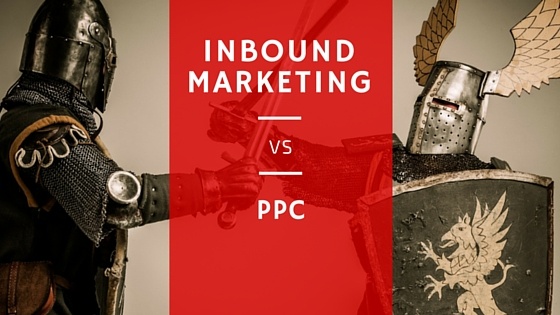
Inbound Marketing vs. PPC: Which should you go with?
About the Author: Uri Bishansky

Find me on:
Introduction
This is a fairly common question asked by lots of businesses. Every business has a limited amount of resources (human, cash, time) and needs to utilize those as efficiently as possible.
The truth is that both methods have their ups and downs: there is no single right answer here, just like pretty much anything else concerning marketing. It depends on your business, budget, target group, website content, design, short term and long term goals, company vision and a few dozens of other things.
To make your life a little easier, we have put together a comparison of inbound marketing vs. ppc so you know what you are dealing with when you make your decision. Let’s jump in.
Short Term Solutions: PPC
Depending on your present conditions and goals, you need to decide what does your business need: Do you need traffic? Do you need conversions? Does your website have the content needed for conversions? Are you confident your sales team can handle leads well?
Answering questions like these will help you understand which strategy you have to pick, when and why.
Pay Per Click can be considered a short term solution in terms of driving website traffic, which will help you bring in tons of qualified visitors when managed correctly. You basically pay a third party site (say Google) to post your ads on their website.
The idea is that if a company spends enough time and budget on keyword research, bid management, keyword match type, clever targeting, site links, negative keyword removal and scheduling, they’ll get a good amount of qualified visitors that are very interested in their services. If enough budget is spent on ads, the tactic will produce rather satisfying results. Here is a detailed Pay Per Click ROI calculation guide you should check out.

(Source)
On the downside, the value of PPC ends there. It does not guarantee that visitors will convert on your website, or that they will ever become one of your customers, unless you have high quality, top notch content and design to encourage conversions and purchases.
Another thing to think about is that the traffic stops flowing the moment you stop paying for ads. Its super inconsistent and is only there while you have cash to fuel it, otherwise your website visits will be brought down to what you had before starting your Pay Per Click campaign, regardless of how long it lasted.
What this technically means is that Pay Per Click is a good, short term solution for getting highly qualified website traffic for a company that has pretty damn good infrastructure (compelling content and intuitive design mainly) to advance the visitors in their buyer’s journey. It won’t take too long either: your website visits will grow like mushrooms in a forest on a rainy day.
Long Term solutions: Inbound Marketing
Inbound marketing offers more of a long term solution for businesses in terms of consistent, high quality website traffic, lead conversions and customer gain. It’s a much slower take off than in the case of Pay Per Click (a well-executed inbound strategy typically takes around 6 months to start producing results), but on the upside, whatever you get in terms of traffic, leads and customers, will stay with you for a very long while. In some cases (evergreen content) website traffic will be there forever and you won’t need to continuously worry about it.

Today, most people use search engines to research any purchase decision they are willing to make, be it a service or a product. Studies show that 81% of customers research products online before going to the store. Because of this absurdly large number, SEO has quickly become one of the most important online marketing aspects for any company.
Here is a chart showing the impact of SEO on US consumer market:

(source)
Inbound offers search engine optimization with the help of creating high quality, relevant, compelling content that will push your content higher on SERPs. This basically means putting in tons of hard work and effort to make your way to the top, instead of buying it (in case of PPC).
Also, by giving away high quality content (whitepapers, eBooks, infographics, etc.) for free, helps build trust among your audience and position yourself as a thought leader in the industry. This way you will not only gain high quality traffic thanks to search engine optimization, but also acquire a good number of qualified leads for a much lower price and build trust with them. All of these efforts combined will eventually lead to gaining loyal customers.

(Source)
The downside of inbound is that it accepts nothing short of selfless dedication, patience and consistency. Everything you do (SEO, content generation and distribution, building trust, offering valuable tips to consumers, etc.) take a lot of time to get started and more often than not, you won’t see any satisfying results for the first few months, in contrast to Pay Per Click.
Also, if you someday decide to put your inbound campaigns on hold, it will basically result in a few months of work, cash and effort lost for nothing. You need to make sure that you have the dedication, budget and patience first, before taking the initiative with this approach.
Read more about Inbound Marketing:
- 5 Steps to prove to your CEO that Inbound Marketing can generate ROI
- How Can i reach my target audience
Conclusion
To sum it all up, inbound marketing is a perfect solution for almost every business out there. It will provide very high ROI in the long run, along with a stable sales funnel, consistent website traffic and highly qualified leads for as long as you maintain quality content production (which you are going to do no matter what strategy you choose to go with).
PPC campaigns can work miracles when a business is in need of a strong traffic boost in a very short amount of time. It’s an effective way of getting qualified prospects and converting them with the high quality traffic you already have on your website.
While both strategies have their ups and downs, getting the best out of both worlds can be a good plan to go with: you basically get the ball rolling with PPC and focus your efforts on inbound to keep it rolling.
If your found this useful, and you’re curious to learn more and find out how to create a long lasting inbound marketing strategy, we invite you to download our How-To guide for creating an inbound marketing strategy.

Uri Bishansky
Uri is the co-author of the Amazon no.1 Bestseller "The Smart Marketer's Guide to Google AdWords". He has been programming since he can remember himself. He lives by excels and numbers, rides bikes, loves dogs and a keen self-educator. Uri has a degree in finance and has been a google partner since 2013.
SHARE THIS STORY
Uri is the co-author of the Amazon no.1 Bestseller "The Smart Marketer's Guide to Google AdWords". He has been programming since he can remember himself. He lives by excels and numbers, rides bikes, loves dogs and a keen self-educator. Uri has a degree in finance and has been a google partner since 2013.


