How to audit your Google Adwords campaigns performance
About the Author: Uri Bishansky

Find me on:
Introduction
Whether you manage your Adwords efforts in-house or outsource them to an agency, knowing how to audit the performance of the campaigns is critical. It’s easy to get dazzled and even mislead if you do not align your campaign KPIs with your business objectives.
Make sure to evaluate how effective your Adwords efforts are in achieving your key business objectives by setting clear and relevant KPIs. The metrics should reflect what you would like to measure. When your campaign is targeted to generate online sales, the auditing is pretty straight forwards. You compare the cost to the revenue – since everything occurs online it’s easy to understand clearly.
Things get more complex when your campaign is targeted to generate offline sales.
The key metrics to evaluate
| Metric | Explanation |
| Clicks | The number of times users clicked your ads |
| CPC | Cost Per Click |
| Cost | The total amount spent on your campaign |
| Leads | Total number of leads generated from your campaign |
| CR | Conversion Rate from click to lead |
| CPL | Cost Per Lead |
| SQL | Sales Qualified Leads – validated leads who have shown interest in the campaign product and the credentials are validated |
| Lead -> SQL CR | Conversion Rate from Lead to Sales Qualified Lead. This metric can help you evaluate the general quality of your leads. A good conversion rate indicates high quality leads. Whereas a low conversion rate indicates poor lead quality. |
| Customers | Total amount of new customers generated from your campaign |
| SQL->Sale CR | Sales Qualified Leads to a new customer conversion rate. Used to evaluate the efficiency of the sales team. |
| Revenue | The direct revenue derived from the campaign |
| ROAS Rate | Return On Advertising Spent . This helps evaluate the overall profitability of the campaign and to evaluate the revenue generated for each dollar spent. |
Evaluating
The best and most important KPI you can set for your campaign manager is ROI rate. Setting this KPI insures that you get your desired return on investment. The rule of thumb is to NEVER set your campaign KPIs by cost per click, impressions and even not leads.
Here’s a quick example to prove this rule:
Let’s take an example of a professional online marketing school who is trying to sell courses. Each course costs 1,000$ and requires a graduate degree in order to enroll.
Campaign A
Keywords targeted – “PPC campaign management course for postgraduates”
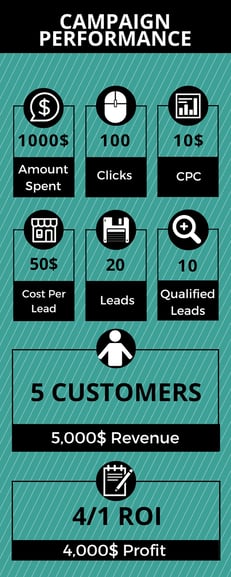
In this campaign each click costs 10$ and each lead costs 50$ which sounds a lot for a 1,000$ potential income.
However, this campaign targets highly relevant keywords that indicate that the user is more likely to convert, be eligible and eventually enroll.
We can see that the Conversion Rate from Click to Lead is high (20%), the Conversion Rate from Lead to SQL(50%) is high and the Conversion Rate from SQL to Sales is high (50%, the prospect knows what course he wants, and is a postgraduate); therefore, the Return on Advertising Spent (ROAS) from this campaign is 4/1.
The bottom line here is that for each 1$ spent the company generates 5$ revenue. Not bad!
Download our 30 Lead Generation Tips, Tricks & Ideas eBook
Campaign B
Keywords targeted – “Online Advertising Courses”
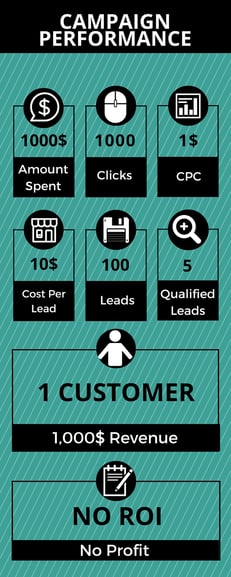
In this campaign each click only costs 1$ and each lead costs 10$. Sounds good right? Look again.
This campaign targets broad terms that indicates that the user is not sure what he wants and might not even be eligible.
For those reasons the Conversion Rate from Click to Lead is lower than in campaign A, the Conversion Rate from Lead to SQL is very low and the Conversion Rate from SQL to Sale is low. (the person doesn’t know what course he wants, and isn’t necessarily a postgraduate) therefor the ROAS from this campaign is 1/1 which means that for each 1$ spent the company generates 1$ revenue. Not very impressive.
This example clearly amplifies why setting clicks or costs per clicks or leads as a KPI is wrong.
We see many companies who make the mistake of not analysing the data once a lead enters their CRM. This creates a blind spot for the company’s Google Adwords campaigns manager who can only set KPIs up to the level of cost per lead.
In such cases the Adwords manager does not have the relevant data to optimize campaigns for better ROI by learning which of the leads became customers and setting customers as a clear KPI.
How can you solve this? By getting sales and marketing on the same page otherwise known as..
Smarketing
In essence, smarketing is the alignment between sales and marketing. That’s not always easy since sales tend to blame marketing for not generating enough leads while marketing blame sales for not selling well to the leads they generate. Getting them to work together isn’t always easy but it’s very recommended.
Technically smarketing requires implementing several technological solutions.
Using a cloud based CRM that integrates with the media buying operation is usually enough on a technical level.
On a practical level, sales and marketing teams tend to not always like cooperating. We recommend implementing in-company regulations regarding workflows, lead scoring and updating the CRM about the sales that eventually occurred offline.
Read more about:
- Tracking Offline Conversions in Google Adwords
- 5 Rules of thumb for creating killer landing pages
- How to create Attention Grabbing Persuasive Calls to Action
Conclusion
The key to success is to make sure your Google Adwords campaigns manager is well aware of your business objectives, and to ensure that you are measuring relevant metrics on your way to generating ROI. Low Adwords costs do not ensure sales. Be smarter, work as a team and use all data you can generate to your optimization advantage.
If your found this useful, and you’re curious to learn more and find out how to improve your lead generation, we invite you to download our 30 greatest lead generation tips tricks and ideas eBook.

Uri Bishansky
Uri is the co-author of the Amazon no.1 Bestseller "The Smart Marketer's Guide to Google AdWords". He has been programming since he can remember himself. He lives by excels and numbers, rides bikes, loves dogs and a keen self-educator. Uri has a degree in finance and has been a google partner since 2013.
SHARE THIS STORY
Uri is the co-author of the Amazon no.1 Bestseller "The Smart Marketer's Guide to Google AdWords". He has been programming since he can remember himself. He lives by excels and numbers, rides bikes, loves dogs and a keen self-educator. Uri has a degree in finance and has been a google partner since 2013.