
Optimizing user experience for SERPs in 2021 and beyond
About the Author: Noa Eshed

Find me on:

Look and behold, the Google Page Experience update is upon us. The new breed of signals will continue to redefine Google’s perception of how people interact with a website and its specific pages, which is a big deal.
Why is this such a big deal, I hear you ask?
Because if you want to deliver a stellar user experience (as you should always strive to), that’s precisely what will be taken into consideration for ranking in the search result as of May 2021 (not that it wasn’t considered till now, but now it’s being taken a step further). The new page experience signals combine refined Core Web Vitals (loading performance, interactivity, visual stability) with existing search signals such as mobile-friendliness, safe-browsing, HTTPS-security, and guidelines on intrusive interstitials.
Unless you’re stark raving bonkers (said in my best British accent) and not going by Google’s guidelines, here’s what you need to know about great user experience in 2021.
Understanding what page experience actually is
Experience is highly subjective so in an effort to quantify it as much as possible within a page, Google has a set of signals it uses for evaluation. Here is the company’s own diagram of what search signals consist of:
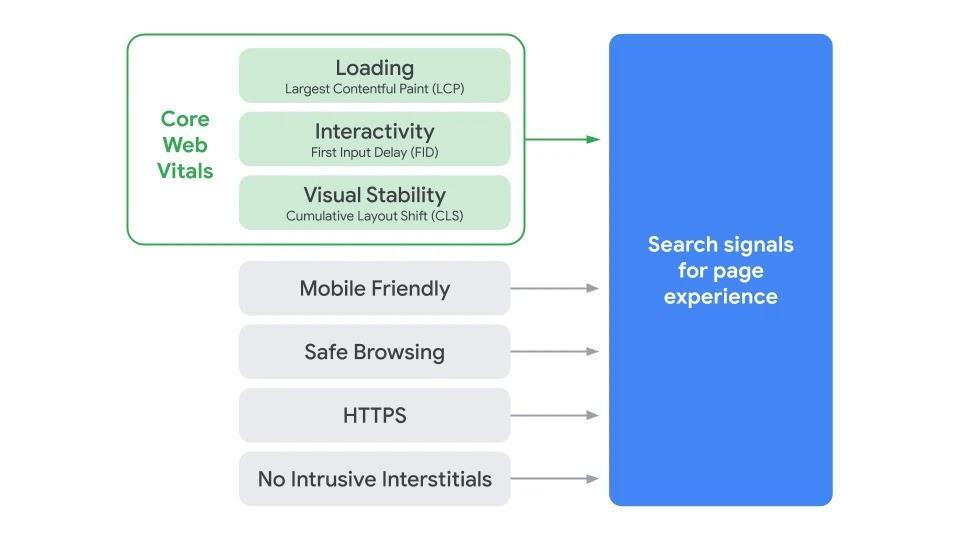
As you can see, there are some familiar names (more or less), with key refinements coming in the cluster known as Core Web Vitals. This is a subset of factors that will influence the final score of your page experience or, simply put – the UX of a specific page. These include three specific measurements with specific criteria:
- Largest Contentful Paint (LCP) measures loading performance or how long it takes a page to load from the first click on a link to displaying most of the content. The focus is on users being able to see content and interact with the page.
Google’s recommendation: have the page loaded within 2.5 seconds of when it first starts loading.
- First Input Delay (FID) measures interactivity or the time it takes for a user to interact with your page like clicking on a link in the navigation menu, filling a form, or tapping on an option on the menu. FID takes into account real-life interaction from the point of first interaction to the point of a browser actually responding to that interaction.
Google’s recommendation: have a FID of less than 100 milliseconds.
- Cumulative Layout Shift (CLS) measures visual stability or as Google says, “the cumulative score of all unexpected layout shifts that occur between when the page starts loading and when its lifecycle state changes to hidden.” In other words, if elements such as links, photos, and fields on your page change positions as the page loads, that’s no bueno.
Google’s recommendation: pages should maintain a CLS of less than 0.1 to provide a good user experience.
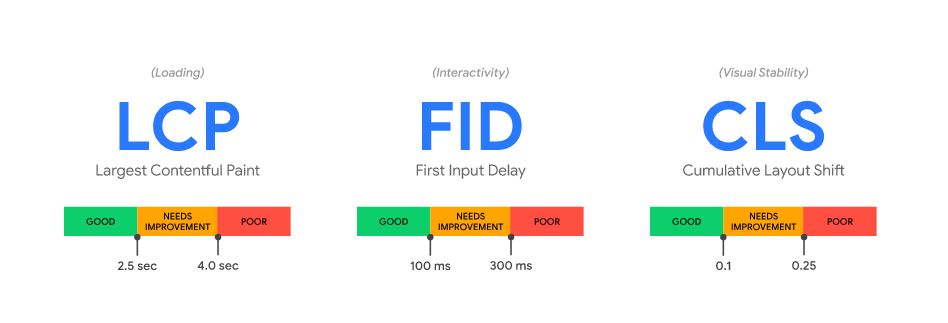
Each of these three metrics represents a separate layer of the user experience and arguably the biggest part of a page experience score. Once again, Google recommends aiming for the 75th percentile mark of page loads across mobile and desktop devices to ensure most of your users have a great experience.
In an additional note, Google plans to test a visual indicator that highlights pages in search results that have a great page experience. Since there is no preview, I think we can expect a label-like version of snippets and image preview for most relevant search results.
How to prepare for the changes
As always, you have plenty of tools at your disposal to get in front of this update and have everything prepared. Right now, three tools are a must:
- Core Web Vitals report in Google Search Console is crucial to get a bird’s eye view of how your site is doing overall and then performance grouped by status, metric type, and URL group (groups of similar web pages).
- PageSpeed Insights continues to be the go-to tool to make a page faster, offering a deep analysis of a web page’s content, then coming up with actionable suggestions on both mobile and desktop devices.
- Lighthouse is similar to PSI an automated website auditing tool that helps developers diagnose issues and identify opportunities to improve the user experience of their sites.
It might be a good idea to look into Web Vitals Chrome Extension and WebPageTest for a quicker and equally in-depth view. Google also offers plenty of dev-oriented tools for those with the know-how which may or may not be a stretch for most of the publishers out there.
Why is this happening?
Well, it’s Google – they can do what they want. But seriously – the search engine company is pretty big on user experience and their ability to identify what your content is about and how helpful and relevant it is to what people are searching for. The company has been systematically tweaking the behind-the-search processes and it’s not going to stop. From things like the E-A-T rating to search trends and a lot of stuff in between, what Google says, goes.
There’s no other way to say it: page experience is important for the overall ranking. Great page content is a must but if you’re head-to-head with another page that offers almost the same level of quality and relevance, page experience can be that tipping point for visibility.
So, understanding how UX is changing and what you can expect going into 2021 and beyond (until a new update rolls out) is vital to staying relevant. There’s plenty of time to be ready come May 2021 – make sure you don’t fall asleep at the wheel.
Bonus tip: don’t sleep on audio
In the past few years, an audio revolution has quietly been going on (see what I did there?). Audio has made a huge push to reach a mainstream-like status and Google has noticed. In terms of user experience, people expect to be able to consume content via audio. An audio version of the content (where applicable) is quickly becoming a preferred way of content consumption for a large and constantly growing user base. Audio maintains a focus on the audience’s needs by being portable (you can listen to it anytime and anywhere), which ultimately enhances their content consumption experience. I fully expect audio’s importance to grow over time, up to the point where a page would get very low ranking if it doesn’t offer a listening experience.

Noa Eshed
Noa is the co-author of the Amazon no.1 Bestseller "The Smart Marketer's Guide to Google AdWords" and co-host of the podcast "Real Life Superpowers". She's a content lover, certified journalist & lawyer (Hebrew U). She practices martial arts & yoga. She's been consulting and helping businesses create a significant presence online since 2010.
SHARE THIS STORY
Noa is the co-author of the Amazon no.1 Bestseller "The Smart Marketer's Guide to Google AdWords" and co-host of the podcast "Real Life Superpowers". She's a content lover, certified journalist & lawyer (Hebrew U). She practices martial arts & yoga. She's been consulting and helping businesses create a significant presence online since 2010.


